Grid 101: Generation 1#
While future blog posts will discuss in more detail the importance and implications of advanced sensor data, this post will aim to introduce the general grid concepts of generation, transmission, and distribution.
The grid consists of three major processes : Generation, Transmission, and Distribution
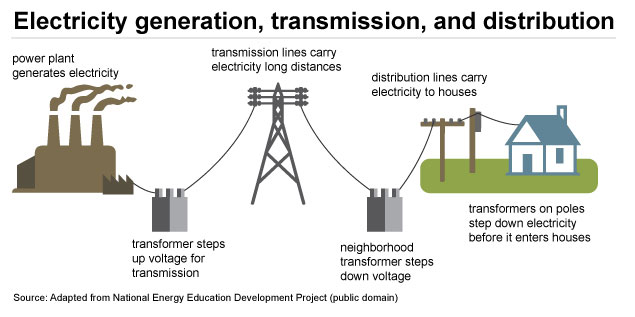
Before we can transport electricity, first we must explore how it is generated in the first place.
How is electricity generated?
What is the difference between alternating current and direct current? (AC and DC)
In 1831, Michael Faraday invented the world’s first electric generator by converting magnetic force into electrical force through using a rotating magnet to excite electrons in a conductive material. Fast forward to today, we harness this electricity in the form of Alternating Current (AC) to power our grid.
When electrons in a conductive material like copper are excited by a magnetic field, those electrons travel freely and generate electric current. In a battery or photovoltaic (solar) powered system, these electrons move in one direction generating direct current, or DC power. While we might be familiar with this concept of electrons traveling in this circular framework, this is surprisingly not the type of current that we interact with in much of our daily life.
DC Generation:
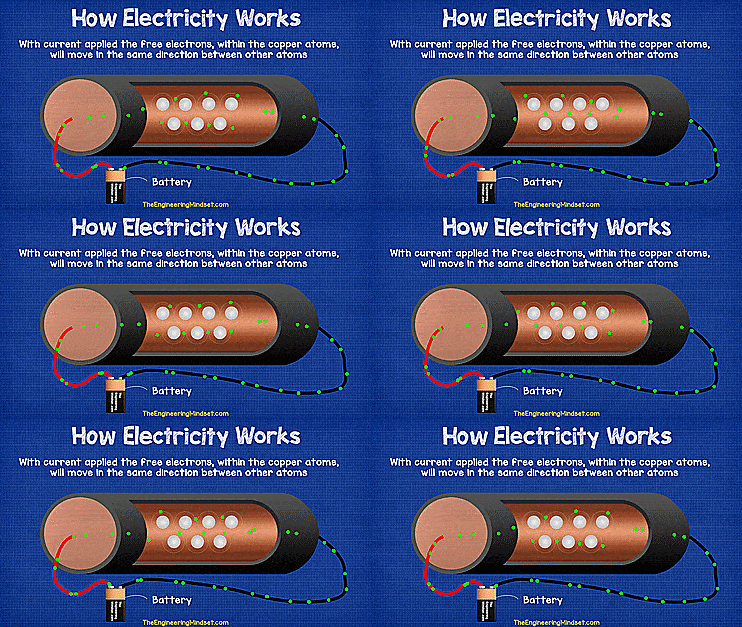
Direct current is the type of current that flows from a battery. In elementary models of electricity, we imagine electricity flowing in a circular motion. Interestingly, it is not the case that one single electron starts in one position and travels around the circuit in a loop, but rather the electrons all move slightly in a general direction across a lattice metallic structure.
While most of our grid is powered by AC current, there one exception where we do see DC current used in general grid operations. A high-voltage. direct current (HVDC) electric transmission system is sometimes used to transport current across large distances. In fact, a 2019, 1,100 kV system in China was completed in 2019 that transported electricity over 2,100 miles! The benefits of these systems will be discussed in further blog posts.

In conclusion, electricity can come in the form of alternating current (AC) and direct current (DC). While electrons move in one direction in direct current systems, excited electrons move backwards and forwards in AC systems. . This process of generating electricity is the key component of generation as a whole: one of the three larger processes that make up the electric grid. After electricity is generated, it is transmitted, before finally distributed locally. In our next post, we will dive into alternating current, the type used most frequently to power our grid.